After 40 years, Dorothy 'Toby' Tate murder solved through forensic genealogy
By Camille DeVaul · Thu Jan 22 2026
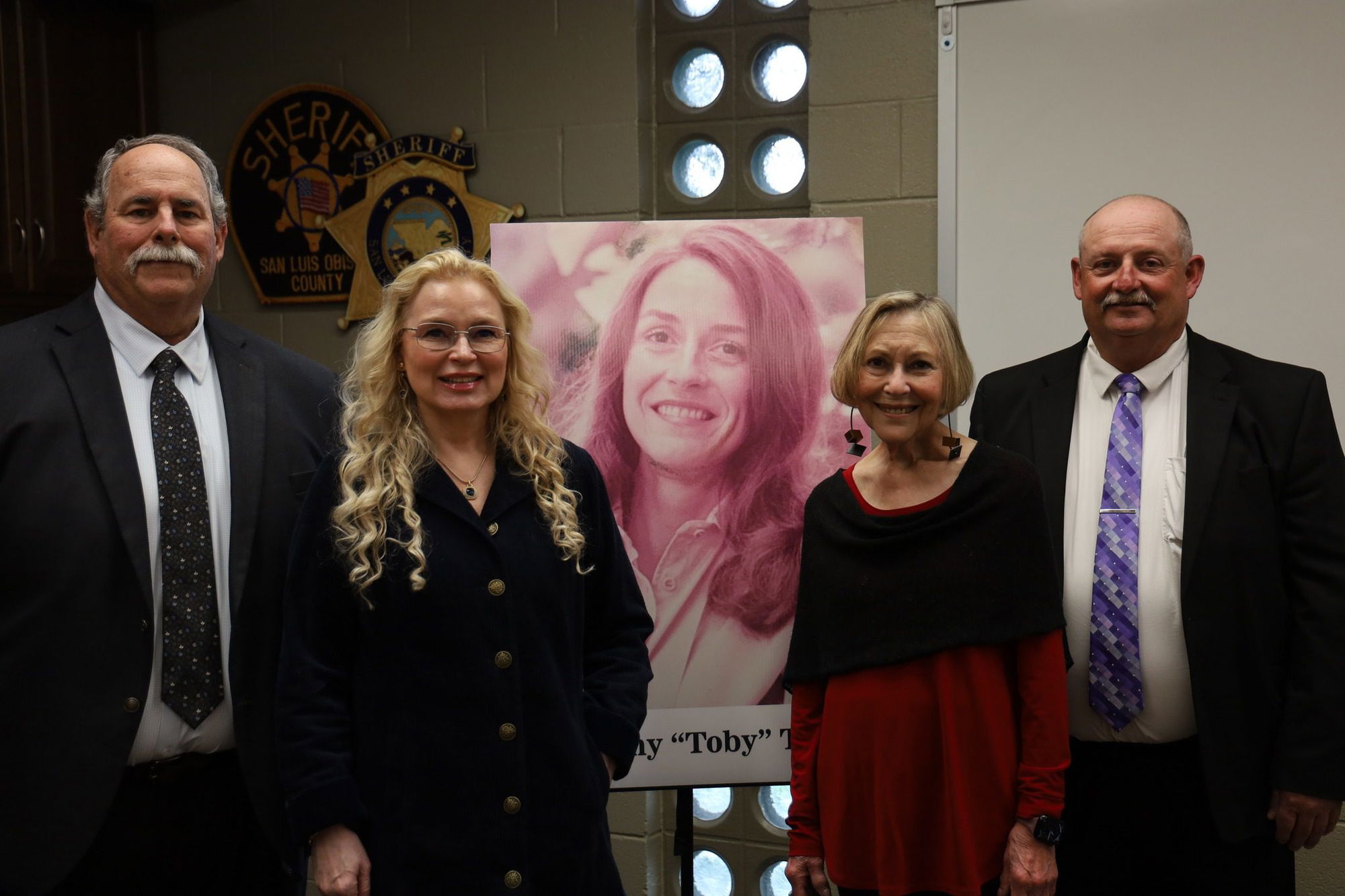
SLO County detectives, working with renowned genetic genealogist CeCe Moore, identified two suspects in the 1983 Highway 1 killing
SAN LUIS OBISPO COUNTY — A family received some resolution in a question they have had for over four decades — who murdered Dorothy "Toby" Tate?
The San Luis Obispo County Sheriff's Office announced on Tuesday, Jan. 20, that they have finally solved the Nov. 15, 1983, murder of Toby. Back in 1983, deputies responded to a report of a suspicious van parked at a turnout along Highway 1, approximately 3 miles north of Hearst Castle. Inside the van, detectives discovered the body of Toby, who had been fatally shot. The case initially yielded no known suspects and quickly became an unsolved, cold, "whodunit" case.

The Detectives
The detectives assigned to work on the case included
San Luis Obispo County Sheriff's Detectives Clint Cole and Jeff Robasciotti. About two years following Cole's retirement in 2023, he returned to the department to help with some of the county's still unsolved and cold cases. One of which included Toby's murder, a case he and Robasciotti decided to work on in 2018.
Cole is known for his work on solving the Nancy Woodrum and Kristin Smart cases. Robasciotti has been with the department for nearly 40 years. After retiring in 2018, he shortly returned to work as a reserve detective, assigned to the county's sexual assault felony enforcement unit, where he supervises the 290 registered sex offenders within the county.
Basically, you can't keep these two from working to solve crime mysteries.
They have a long history of working together in the department. While Cole was pulled into working on the Smart case, Rabosciotti had his nose to the ground searching for who killed Toby.
"It's nice to have somebody to bounce things off of each other," Cole told Atascadero News.
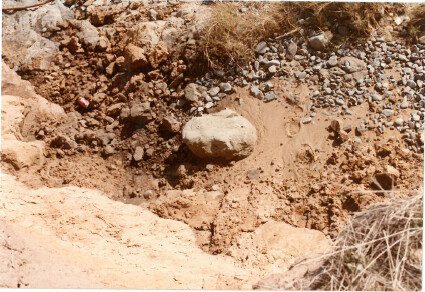
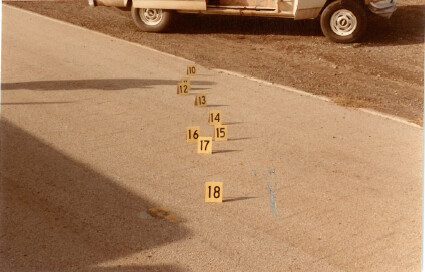
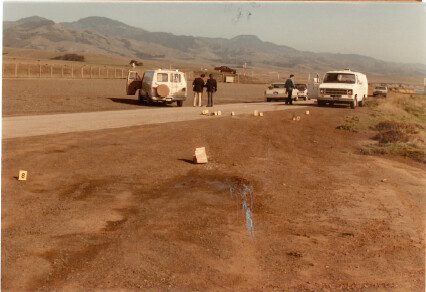
This was the scene on Highway 1 near Hearst's Castle in November 1983, where deputies found the body of Dorothy "Toby" Tate, who was fatally shot, in a van parked by Highway 1. Contributed photo
Back in 1983, detectives leaned into theft as the motive for Toby's murder. Toby, who was travelling through the Central Coast with her two dogs, was shot while seated in the driver's seat through the window. The suspects then pulled her into the back of the van. An autopsy showed no signs of sexual assault, so with some items missing, robbery was left as the motive.
Toby's brand new Nikon camera was missing, along with her purse and other belongings. Her sister Priscilla recalls being told at the time of the crime that Toby may have been seen by the suspects cashing a $400 check nearby, though that information was not within the case files.
Initially, no suspects came up for detectives for many years. According to Cole, some local men were checked out, but still no hits.
Two years later, Toby's camera was found at a pawn shop in Bakersfield after the family was able to provide the camera's serial number. This led to some people of interest, men who at one time possessed the camera. Still, no one fit the bill.
By the mid 1980s, the case was considered cold.
Despite the cold temp of the case, not all was lost for detectives. Found at the scene was a Coca-Cola can with fingerprints and drops of blood not belonging to Toby. The evidence was kept in great condition, most likely in hopes of using the blood evidence for blood typing — a method commonly used before DNA to rule suspects out by comparing blood types.
"In a homicide, you collect everything," Cole explained. "They were just collecting everything. The coke can was far enough away [from the scene] that they collected it, but they never really paid a lot of attention to it. Detective Robasciotti did, and that's how we identified Sneed."
Charley Sneed
Charley Sneed of Texas was the first suspect identified in Toby's case.
"Charley Sneed had an extensive criminal history," Robasciotti explained. "Shortly before the homicide, he shot up a woman's vehicle in Texas because he blamed her for his pending divorce. She was best friends with his wife."

Another charge came from a drunk night on the town when Sneed fired shots from his rifle — witnessed by some officers on the bluff above him. Following Toby's murder, Sneed was booked for aggravated kidnapping of the ex-husband of the woman whose car he fired shots into.
He was in prison until 2009 and later died in 2014 from natural causes.
But who did the blood belong to? That was a question only CeCe Moore could help answer.
The Genealogist
After traditional investigative avenues were exhausted, the Sheriff’s Office turned to forensic genealogy to advance the case. Once the Department of Justice laboratory developed a DNA profile from the blood evidence, it was uploaded to CODIS, but no direct match was found. Investigators then attempted a familial search within CODIS, which looks for close biological relatives such as parents or siblings, but that effort also yielded no results. With those options exhausted, the Sheriff’s Office contracted with Parabon Nanolabs to pursue investigative genetic genealogy, a next-step approach increasingly used in cold cases. Parabon genealogist CeCe Moore agreed to work the case, and the DNA evidence was transferred to her for analysis.
Forensic genealogy first came onto the crime-solving scene in 2018. Among the first killers identified using the technology was the Golden State Killer (Joseph James DeAngelo). Moore has been a leading expert in the field since its introduction. She has appeared on numerous television programs, including "The Genetic Detective," and has helped law enforcement identify suspects in more than 300 cold cases using DNA and genetic genealogy.
Moore also works as the chief genetic genealogist with Parabon NanoLabs, and chose to work on Toby's case personally when the Sheriff's office came to her lab for help.
"Detective Cole and I worked very closely together in order to finally get this case over the finish line," Moore said. "It was very difficult because we were initially working on the suspect's father's side, and it turns out they were not connected on paper."
Working collaboratively, detectives and the genealogist combined their expertise to build a family tree and narrow potential suspects.
“Typically, we work with second, third, fourth, fifth cousins and beyond," Moore explained. "We reverse-engineer somebody’s DNA based on those cousins in the database.”
While Moore focused on genealogical research, investigators assisted by obtaining vital records such as birth and death certificates, contacting agencies in other states, and, when needed, collecting DNA samples from potential relatives to confirm or eliminate family lines. This back-and-forth process helped ensure the genealogical research stayed on the correct path.
After key records were provided, Moore rapidly narrowed the DNA to a close family connection and identified Stephen Hardy as the likely contributor.
Once Hardy was identified, the investigation shifted back to law enforcement. Detectives located Hardy’s sister in Phoenix and coordinated with the Phoenix Police Department to collect a voluntary DNA sample. The sample showed a very high-probability familial match, effectively confirming Hardy as the source of the DNA and ruling out other potential relatives.
Combined with fingerprint evidence linking Charley Sneed, investigators concluded with certainty that Hardy and Sneed were responsible. The case marked the Sheriff’s Office’s first successful use of investigative genetic genealogy, a technique they have since begun applying to other cold cases due to its proven effectiveness.
"This case would not be solved if it weren't for the detective's dedication because it was very difficult. It took a lot of collaboration between us," Moore said.
Moore explains she manages dozens of cases at a time, concentrating her attention on a smaller group while overseeing a team of four additional genealogists who collectively handle hundreds of ongoing investigations. Now, Moore said she is actively working on five unsolved cases. She also noted a common challenge in genetic genealogy investigations: many cases involve unknown or undocumented fathers — a challenging element she found in this case.
She explains that even though the strongest DNA matches frequently come from the paternal side of the family, this complicates efforts to definitively identify suspects.
"Your DNA tells the truth of what your ancestry is whereas the paper trail sometimes lies," Moore says.
Stephen Hardy
Stephen Hardy was a Vietnam War veteran originally from Ventura County, born in San Diego, who led a transient lifestyle following his divorce after the war.

Family members reported to Robasciotti a history of mental health issues and believed he may have been bipolar, though he was likely never formally diagnosed. His mother died by suicide in her early 30s and was also said to have struggled with mental illness. Hardy married just before leaving for Vietnam and divorced shortly after returning.
His criminal history consisted primarily of minor, nonviolent offenses such as public urination, trespassing, drunk driving, and passing a bad check, with arrests in California, Arizona, and Texas; no serious felonies were found. Court records place Hardy in Texas as early as May 1983, when he wrote a bad check, though he was not arrested for it until February 1984, shortly after the Toby's murder. He worked in the oil industry while in Texas and was known to have been associated with Sneed during that time, though the nature of their connection remains unclear. After his Texas arrest, Hardy posted bail and was no longer seen there. He later spent time at a veterans hospital in Phoenix and died in 2003.
A Resolution
Though the suspects have been identified, and other potential suspects have been ruled out, justice cannot be served any further.
"It was a relief when we finally figured out who he was," Moore said. "But disappointing because he was deceased and would not be facing justice, and it was difficult to find out a lot about him."
Not only can justice not be served in the courts, but the many frustrating details of "why?" died along with the three who were there.
Being in San Luis Obispo to help announce the case's closure was important to Moore, "The main reason I drove up here today was to meet Dorothy's sister because I do, especially if I work a case for a long time, I get a real emotional investment in the victim and her loved ones."
Each detective expressed what it meant to them to be able to bring at least some peace to Toby's family.
"It's very rewarding," Robasciotti said. "It was rewarding listening to Priscilla talk. That's quite emotional. You just want to bring some type of justice for the victim. The victim is always the center of these cases, her life was taken at a very young age. I have children close to her age ... it's nice to be able to give the family as much closer as you can."
"I'm so grateful Priscilla was able to come. It makes it even more rewarding," Cole said. "I've always looked at it having investigated sexual assault cases with children. We can be the voice that the victims can't be the voice for themselves, and obviously, murdered victims can't tell their story."
The case, over 40 years later, is now considered closed.
The Sheriff's office said in a press release: "Given the totality of the evidence, the Sheriff’s Office has requested and received review by the District Attorney’s Office, confirming that sufficient probable cause exists to support prosecution had the suspects been alive. The case has now been officially closed as 'exceptionally cleared.'"
Moore encourages members of the public to upload their DNA profiles to sites such as GEDMatch, FamilyTreeDNA, and DNA Justice to help create more genetic connections in unsolved cases. Cole says the Sheriff's office is looking forward to working with Moore to close more cases using forensic genealogy to help solve them.
"The San Luis Obispo County Sheriff's detective division solved his case, because without the work of the investigators back in '83, collecting the blood evidence, collecting the Coke can, they had to do their job right to allow technology to catch up 43 years later. So it's really a team effort," Robasciotti explained.
Both detectives expressed how thankful they are to have SLO County Sheriff Ian Parkinson support their efforts.
"Sheriff [Ian] Parkinson is amazing in his support of what Clint does ... We talk to other cold case units and they can't get funding," Robasciotti said. "They can't get this, they can't do that. They can't do a lot of the tests that we're able to get done."
"It's truly not an exaggeration," Cole added. "Sheriff Parkinson has never said no. These cases are expensive ... I don't have to worry about it, because Sheriff Parkinson supports these cases. We don't hear that much."
The Sheriff’s Office wishes to thank Parabon Nanolabs and Head Geanologist CeCe Moore, Othram Labs, Shelby Liddell with the Sheriff's Crime Lab, and Dominick Rostenberg from the Phoenix Police Department.
“This case demonstrates the power of modern forensic science and the commitment of Detective Cole, who never stopped working to bring justice to victims and their families,” said Parkinson.
Feature Image: (From left) Detective Jeff Robasciotti, Head Geanologist at Parabon Nanolabs CeCe Moore, Toby's sister Priscilla Tate, and Detective Clint Cole pose with a photo of Dorothy "Toby" Tate after the killers had been identified in the 1983 shooting death of Toby Tate. Photo courtesy of the SLO County Sheriff's Department